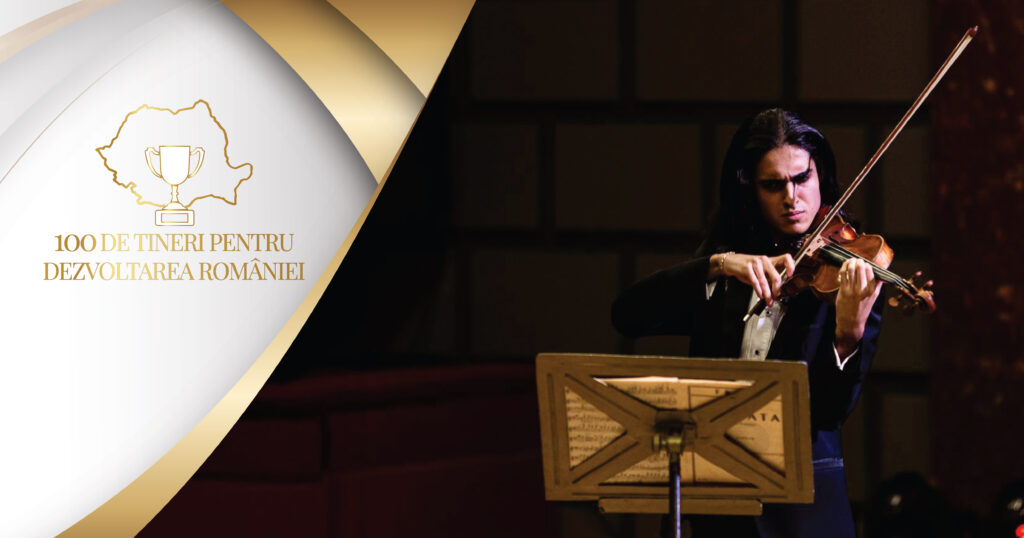
The violinist Antonio Piculeață, a name already recognised in the elite of young European musicians and Cultural Ambassador of Romania at only 18 years of age, has joined the "100 Youngsters for Romania's Development" campaign. The campaign is organised at national level by the Dan Voiculescu Foundation for the Development of Romania.
Antonio is a laureate of the "Remember Enescu" competitions and of the National Music Olympiad, where he was awarded first prize and the special prize, and he was also a finalist of the "Chieti Classica" competition in Italy. Antonio's performance as the first violinist to play in the Aula of the Romanian Academy represented a significant moment in the convergence of academic and artistic excellence. Throughout the years, he has given recitals and concerts in a number of distinguished concert halls. The Romanian Athenaeum, the National Opera, the Philharmonic Orchestras of Brasov, Sibiu, Craiova and Ploiesti have performed in a variety of international venues, including the European cultural capitals of Vienna, Berlin and Brussels, as well as in the USA in New York. At the commencement of the present year, Antonio was designated Cultural Ambassador of Romania, an accolade bestowed upon him by the esteemed director Serge Celibidache.
Antonio commenced his violin studies at the age of six, and three years later, he made his solo debut with the esteemed Medici Orchestra, under the baton of Iosif Prunner, on the stage of the distinguished Romanian Athenaeum. Subsequently, he performed Mozart's Violin Concerto No. 3 with the Oltenia Philharmonic Orchestra of Craiova, under the direction of Măldălin Voicu. The trajectory of his career has been significantly influenced by formative encounters with esteemed violin masters. It was in 2019 that Roman Kim first became aware of the young musician, and subsequently assumed the role of mentor. Under Mr Kim's tutelage, the violinist has been introduced to advanced techniques. He has had the opportunity to study with renowned musicians including Roman Kim, Li Lin and Kenneth Renshaw (Juilliard School), Viktor Basis (Lucy Moses School of Music, New York) and Nicola Benedetti. Notable collaborations include those with Canadian pianist Tony Yike Yang, with whom he has performed works such as César Franck's Sonata, Saint-Saëns' Rondo Capriccioso, Edward Elgar's Salut d'Amour, Fritz Kreisler's Syncopation and Paganini's Cantabile. Participation in international projects such as "The Nicola Benedetti Global Violin Sessions" is indicative of Antonio's commitment to collaborative endeavours within the field. Such participation has enabled him to collaborate with artists of the highest international calibre, and to be discovered by Geza Hosszu-Legocky, who is also known by the name Gezalius. It is through this collaboration that Antonio has been introduced to the subtleties of chamber music and the sound of the golden age.
Antonio Nicholas Piculeață was born in New York, and hails from a family with deep musical roots. His grandparents, Aurel Piculeață and Ionel Puia, were accomplished classical violinists who possessed a particular affinity for traditional Romanian music. The subject's parents, Loredana and Relu Piculeață, are also musicians. Loredana is a teacher at the Dinu Lipatti School of Music in Bucharest, while Relu is a graduate of the Bucharest Academy of Music. In the present day, Antonio Piculeață is engaged in musical study in Vienna with the violinist Dora Schwarzberg, and he continues his artistic journey with the same determination and sensitivity that characterised him at the outset. Despite residing in Bucharest with his parents and holding dual Romanian-American citizenship, Antonio continues to demonstrate a strong affiliation with Romanian culture.
The inclusion of Antonio Piculeață in the campaign "100 Youngsters for Romania's Development" is a confirmation of his value and potential. The initiative of the Dan Voiculesulescu Foundation for the Development of Romania aims to promote exceptional young people who, through hard work, vision and passion, can actively contribute to the country's progress. Antonio fits naturally into this approach, being an elite musician who reconfirms his role as cultural ambassador and symbol of a generation that inspires and builds.