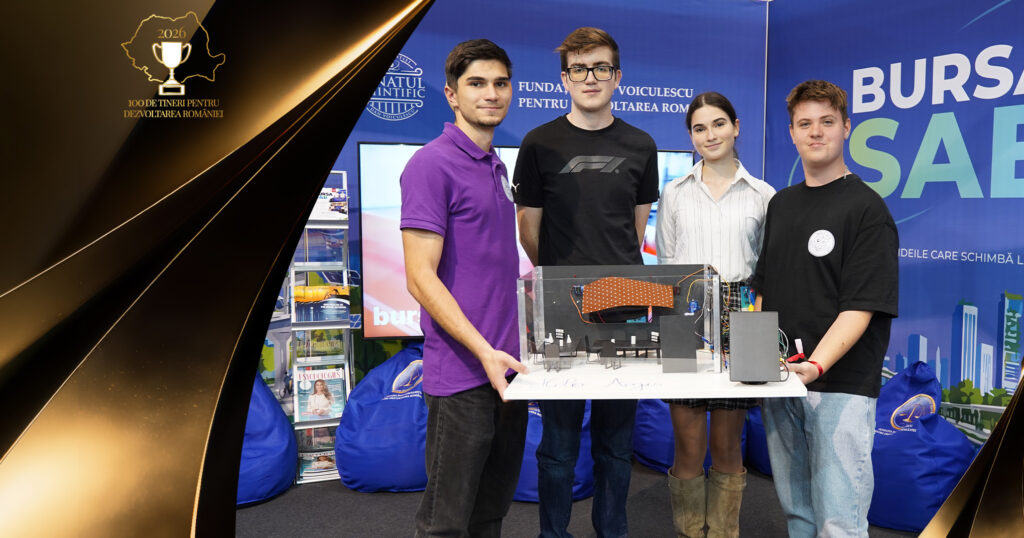
A drone that can identify a person in danger of drowning, an application that moves the work of archaeologists from field notebooks to the digital environment, and autonomous robots built and programmed from scratch. These are not the projects of a research laboratory, but solutions developed by Quantum Bits, the team of innovative students of the International Theoretical High School of Informatics in Bucharest, which was included in the national campaign “100 Young People for the Development of Romania”, run by the Dan Voiculescu Foundation for the Development of Romania.
Coordinated by mentor Mihai Popescu, Quantum Bits students won First Place and the Grand Trophy at the national FIRST LEGO League competition, where approximately 100 teams put their robotics, programming, research, and innovation skills to the test. The competition challenges participants to design, build and program robots using LEGO pieces to solve missions inspired by a different theme in each edition. Beyond the technical performance of the robots, the competitors must demonstrate that they can transform technology into a solution for real problems. And Quantum Bits took this challenge further. The team developed AIDRONe, an autonomous drone based on artificial intelligence, designed to monitor beaches and identify people in danger of drowning. The system proposed by the students uses technology for one of the situations in which every second can count: the fast detection of a possible incident in the water and supporting the intervention of rescuers.
The project shows the direction in which the new generation of Romanian innovators is heading: not only towards spectacular robots, but towards technologies that can have concrete utility and direct impact on people's lives. The students also created Stratum, an application designed to digitize the tools and processes used by archaeologists in their daily work on archaeological sites. The idea arose in the context of a robotics competition with archaeology as its main theme. While documenting, the young people noticed that some of the information collected in the field is still recorded manually, on paper, on labels or directly on the bags in which the discoveries are stored. Quantum Bits' answer was Stratum: a digital solution designed to make data collection and organization faster, safer, and more efficient. Basically, the students started from a problem encountered in a field that is thousands of years old and tried to solve it with the tools of the artificial intelligence generation.
Winning the national stage opened the way for Quantum Bits to international robotics competitions in the United States of America. The team also qualified for the International Robotics Championship in Houston, where young technology enthusiasts from around the world present their robots and innovation projects. For Quantum Bits members, robotics means much more than participating in competitions. These young people design, build and program autonomous robots, but also develop applied research projects, in a process that combines creativity, critical thinking, teamwork, and technological rigor. Their inclusion in the “100 Young People for the Development of Romania” recognizes precisely this capacity to transform the knowledge acquired at school into solutions for the real world.
Through the campaign carried out at national level, the Dan Voiculescu Foundation for the Development of Romania brings to the attention of the public young people who demonstrate that Romanian performance is not measured only in medals and trophies, but also in the ideas that can change things around us. And Quantum Bits demonstrates that, sometimes, the next important solution can start right on the workbench of some students: with a few LEGO pieces, a few code lines and the courage to try to solve a problem that others have accepted as such.