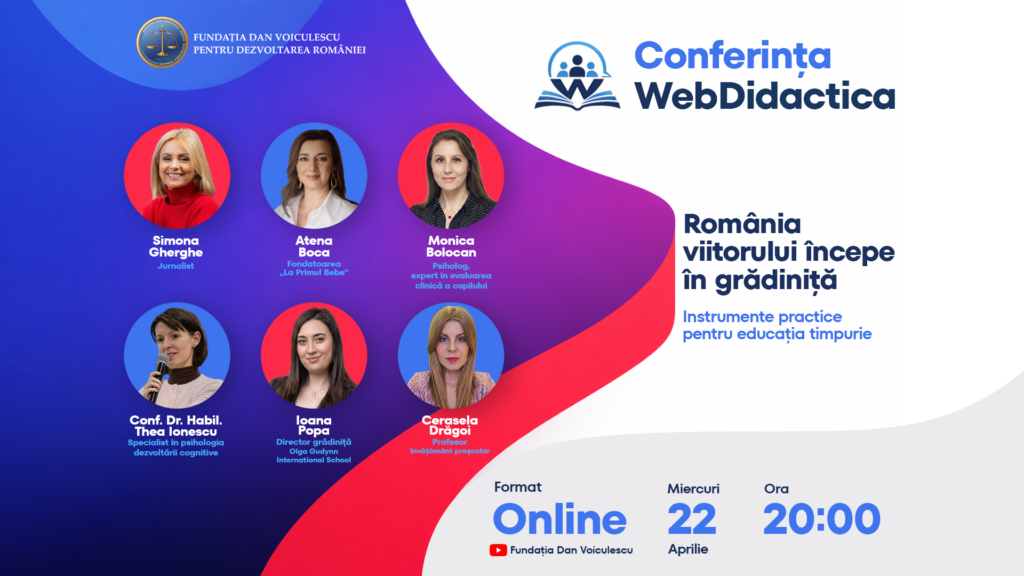
Parents and educators often find themselves facing the same dilemma: how to support a child’s natural curiosity without overwhelming them with unrealistic expectations. Whether in a classroom or at home, faced with an endless stream of questions beginning with “why?”, adults strive to strike a balance between necessary discipline and the freedom to explore. This apparently simple daily interaction actually lays the foundation upon which the future adult will stand. To provide clear guidance in this labyrinth of early childhood development, the Dan Voiculescu Foundation for the Development of Romania is hosting an essential event: The Webdidactica Conference “The Romania of the future begins in preschool - practical tools for early education,” which will be available for free on the Foundation’s YouTube channel starting April 22 at 20:00. The event is part of the “Preschool Olympics” campaign, a national project for which registration remains open to all interested educational institutions.
Understanding how a preschooler’s mind works is the starting point of the discussion, and university professor Thea Ionescu brings deep cognitive mechanisms into the conversation. She explains why executive functions, such as working memory and flexibility, are far more important at this stage than the mere accumulation of information. This scientific perspective is grounded in immediate reality by school inspector Luisa Cerasela Drăgoi, who addresses the urgent problem of fragmented attention. In an age of screens, she offers pedagogical solutions on how to maintain children’s focus in the classroom, transforming guided activities into engaging experiences that counteract digital overstimulation.
Beyond the teaching process, the way we assess and label children’s progress can have a decisive influence on their self-confidence. Ioana Popa, the principal of Olga Gudynn International School, questions the tendency to label children at an early age and emphasizes the importance of distinguishing between a momentary performance and a child’s true potential. This perspective is complemented by Monica Bolocan, a senior clinical psychologist, who elaborates on the concept of authentic assessment. She shows parents and educators how to observe children’s true abilities during everyday activities without creating a stressful testing environment, and how to communicate the results in a way that provides support rather than pressure.
The emotional dimension of education takes a central place, based on the idea that a balanced child needs, first and foremost, a balanced adult by their side. Journalist Simona Gherghe highlights the philosophy that a child should not become a “project” for their parents’ success, but should be allowed to discover their own motivation. This approach is complemented by Atena Boca, the founder of a large community of parents, who speaks about the reality of adults’ emotional resources. She emphasizes the importance of community and combating parental burnout, reminding us that a parent’s mental health is the mirror in which a child’s autonomy and self-regulation are reflected. All these perspectives will be available for free on the Foundation’s YouTube channel starting April 22 at 20:00, offering everyone interested a necessary compass for raising the next generation.