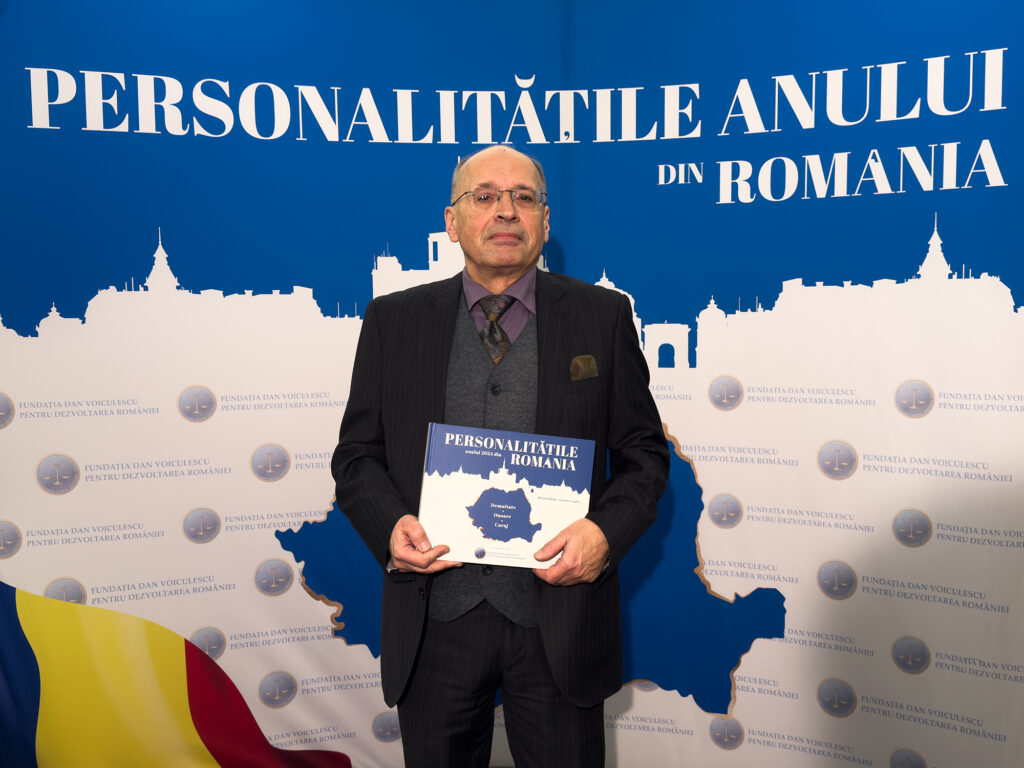
In a cultural landscape that often seems dominated by the fleeting, recognizing values that have stood the test of time becomes an exercise in social hygiene. The Dan Voiculescu Foundation for the Development of Romania has launched the "Romanian Personalities Album", an initiative mapping the country's contemporary elites. Among the one hundred names that define Romania's current performance is Iosif Ion Prunner, the conductor and pianist who has succeeded in transforming the discipline of music into an instrument of cultural diplomacy. His inclusion in this album comes as a confirmation of the impact that the conductor has had on the artistic scene, shortly after he was honored with the award for over two decades of excellence in choral art.
The presence of Iosif Ion Prunner in this project of the Dan Voiculescu Foundation for the Development of Romania is not only a recognition of an individual career, but also a reverence for a tradition that goes beyond a century. Heir to the Prunner-Silvestri family, present on the stage of the George Enescu Philharmonic for over a hundred years, the artist is a living bridge between the rigor of the classical school and the dynamism of the present. For almost three decades, he has been conducting the Philharmonic Choir, an ensemble that he took over at a time of crisis in the mid 1990s and which he has brought to a level of performance that has allowed him to historic collaborations, such as the Berlin Philharmonic in 2019.
For Iosif Ion Prunner, the inclusion in the "Album of Romanian Personalities" has a special significance, being one of the few forms of institutional recognition received domestically. The maestro often emphasizes that music is an international language capable of building bridges of communication both professionally and humanly. Beyond the world's great stages, where he has collaborated with names such as Daniel Barenboim and Zubin Mehta, his work within the Philharmonic has constantly focused on promoting contemporary Romanian works, thus giving a voice to local composers in a global repertoire circuit.
Beyond figures and distinctions, Prunner's vision of the arts offers a much needed angle on the education of new generations. In an age of overexposure, the conductor pleads for a return to the basics and modesty when faced with the score. He believes that young artists should drop what he calls interpretive narcissism, recalling Dinu Lipatti's principle: "serve the music, don't serve yourself". This philosophy of relentless work and inner self realization of the artistic act is, in fact, the reason why the selection made by the Dan Voiculescu Foundation for the Development of Romania has placed him among the central figures of this year.