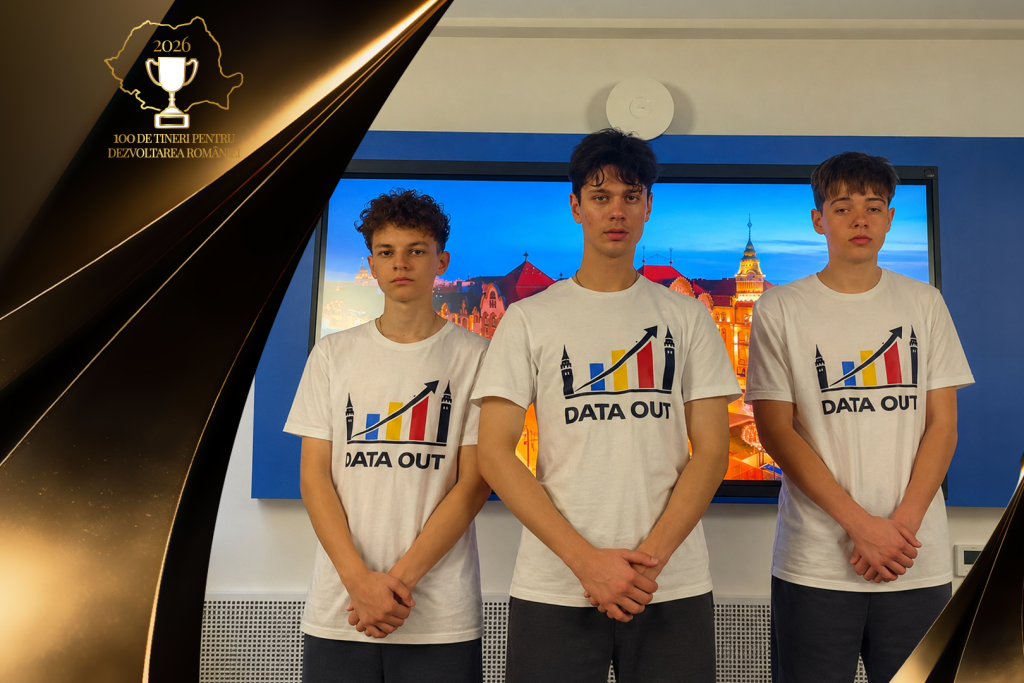
What do numbers say about Romanians when we leave prejudices aside? Three high school students from Oradea turned this question into a project that reached the podium of one of the most important European competitions dedicated to statistics. The DATAOUT team, consisting of Rareș Bogdan Hodăian, Eduard Hoti, and Bogdan Ștefan Silaghi, obtained 3rd Place at the European Statistics Competition 2025-2026, Junior category, after previously winning the 1st Prize, with maximum points, at the National Statistics Olympiad. The 10th grade students of "Onisifor Ghibu" National College in Oradea, coordinated by the mathematics teacher Cătălina Mitrașcă, were included in the "100 Young People for the Development of Romania" campaign, carried out at the national level by the Dan Voiculescu Foundation for the Development of Romania.
The performance of the three teenagers takes on another dimension compared to the scale of the competition. According to Eurostat, almost 29,000 students from 22 countries registered for the ninth edition of the European Statistics Competition, the largest number of participants recorded since the launch of the competition. After the national stages, the best teams reached the European final, where 74 materials were evaluated. This year’s challenge was one that went beyond the simple interpretation of tables or graphs: the competitors had to create, in just two minutes, a statistical portrait of their own country, using official data to show what the people of their country are like in reality. For DATAOUT, the topic turned into a much more interesting question: how much of what others think about Romanians is actually supported by numbers?
Thus, the project “Romanians Unveiled: The Story Beyond Stereotypes” was born, built around the material “Statistical portrait: what are the people of Romania like?”. Instead of presenting a succession of statistical indicators, the three students chose to confront some of the stereotypes associated with Romania with measurable reality. One of the most powerful examples concerned the image of Romanians associated, in certain European contexts, with crime. However, the data analyzed by the students indicated a different reality from this perception: Romania ranks below the European average in the indicators used in the project. Another surprising result came from the area of life satisfaction. The data used by the team places Romania among the European countries with a very high level of declared life satisfaction. The project also addressed education, the economy, digitalization and the contribution of Romanians to the country’s development. Behind the two minutes of final material, however, were weeks of documentation, data selection, verification, interpretation and visual construction.
The team worked on the project for approximately a month and a half, with each of the three members assuming an equal share of the effort. DATAOUT members later spoke of periods in which they ended up working, on average, up to 12 hours a day to complete the project. Eurostat noted the Romanian project for the clear way in which the story was constructed and for the surprising conclusions about what Romanians really are.
It is also an important performance from the perspective of the competition: Romania was among the countries with the largest participation in the 2025–2026 edition. Over 5,300 Romanian students, gathered in almost 2,000 teams, participated in the competition stages, according to data made public by the Ministry of Education. Eurostat emphasizes that this year’s exercise showed how statistics can be used to combat the prejudices and misconceptions that underlie national stereotypes. And DATAOUT demonstrated exactly this: data are not just numbers in a table - used intelligently, they can change a perspective.
The DATAOUT story also shows why such achievements are worth discovering and supporting. In just a few months, three teenagers participating in their first ever statistics Olympiad went from learning the basics to representing Romania on the European podium. In a Europe where Romania is still sometimes viewed through the lens of old clichés, three high school students chose to respond not through speeches, but through evidence. They confronted stereotypes with data and let the numbers speak for Romania.