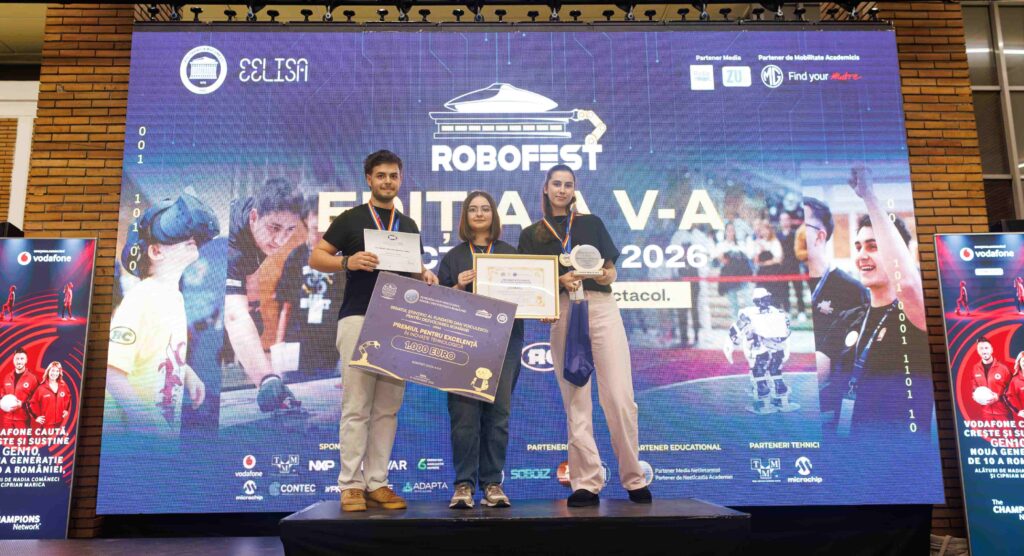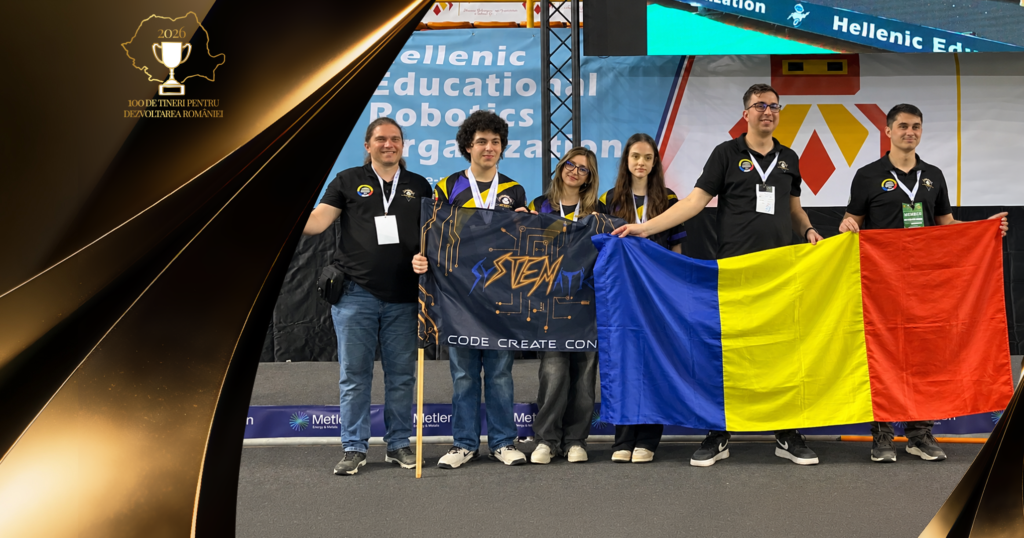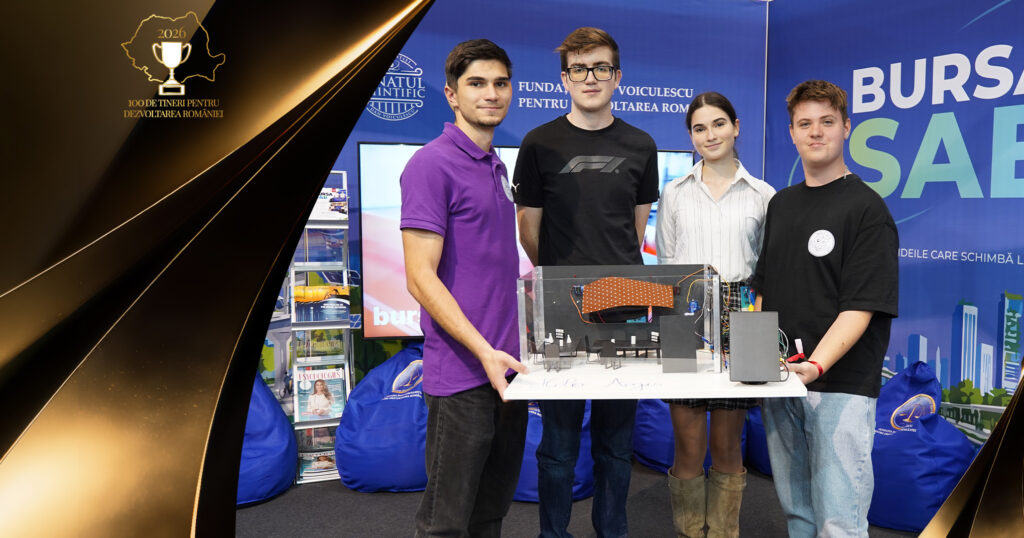
Four 11th grade students from Galați built a prototype of a laboratory that monitors what is happening in the room and reacts automatically: turns the light on or off, starts the ventilation and controls the blinds based on the data received from the sensors. The project is called HELIO AEGIS, and the team formed by Mihaescu Rares-Andrei, Tocu Maria, Leonte Darius-Andrei and Nicodim David-Teodor was included in the national campaign "100 young people for the development of Romania", run by the Dan Voiculescu Foundation for the Development of Romania.
The idea starts from a problem encountered in almost every building: lighting, ventilation, blinds and security systems often work separately. HELIO AEGIS tries to bring them under the control of a single system, capable of making decisions based on information from the room.
The topic has a broader stake. Buildings consume around 40% of the energy used in the European Union, and the European Commission considers automation and smart control to be among the important tools to lower consumption. At European level, there is already a “Smart Readiness Indicator”, designed to assess how well a building can detect changes, interpret them and automatically adapt its operation.
The four high school students from Galați are working in exactly this direction.
Their prototype uses an ESP32 board, presence, temperature, humidity, light and vibration sensors, along with elements that control lighting, fans and blinds. If the room is empty, certain systems can be turned off. If natural light is sufficient, artificial lighting is no longer needed. When the temperature rises, ventilation can be turned on automatically.
Another component of the project concerns emergency situations. The concept stipulates that, in the event of a power outage, the energy remaining in a backup battery would be directed to functions considered essential: controller, sensors, emergency lighting or communications. Consumers that are not needed at that moment would be turned off.
One of the most interesting ideas of HELIO AEGIS comes from the team members' passion for astronomy. Mihaescu Rares-Andrei and Nicodim David-Teodor participated in the National Olympiad of Astronomy and Astrophysics and obtained, throughout their participation, bronze, silver and gold medals.
In a future version, the system could calculate the position of the Sun based on location, time and season, and predict when a window is about to be exposed to direct sunlight. Blinds could close before the room overheats, reducing the energy needed for later cooling. On cold days, the same mechanism could allow natural light and heat to be used when they are useful.
For now, HELIO AEGIS is a prototype, and photovoltaic panels, a larger battery capacity and advanced predictive control are part of the proposed stages for its development. However, the modular architecture would allow the concept to be adapted to school and university laboratories, smart greenhouses, medical premises or technical rooms. The team also sees a possibility of using its energy management principles for electric vehicle charging stations.
The four students come from the "Costache Negri" National College and the "Vasile Alecsandri" National College in Galați. In parallel with the project, they founded the NextGen Science Club, and Rareș and David teach astronomy, physics, and mathematics to children aged 8 to 17.
By including the HELIO AEGIS team in "100 young people for the development of Romania", the campaign brings to attention a project that starts from a school laboratory, but responds to a theme that research and the construction industry are already facing: how do we make the spaces in which we work use energy more intelligently and be able to react on their own when conditions change.