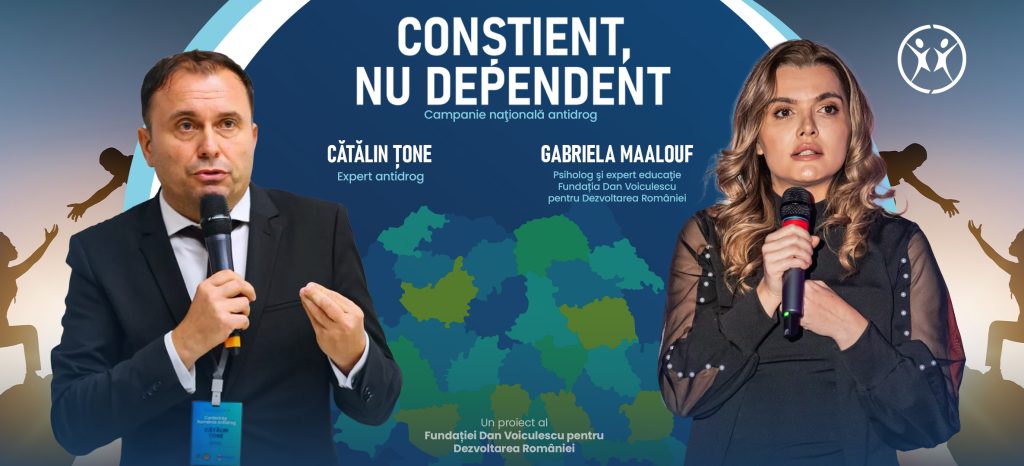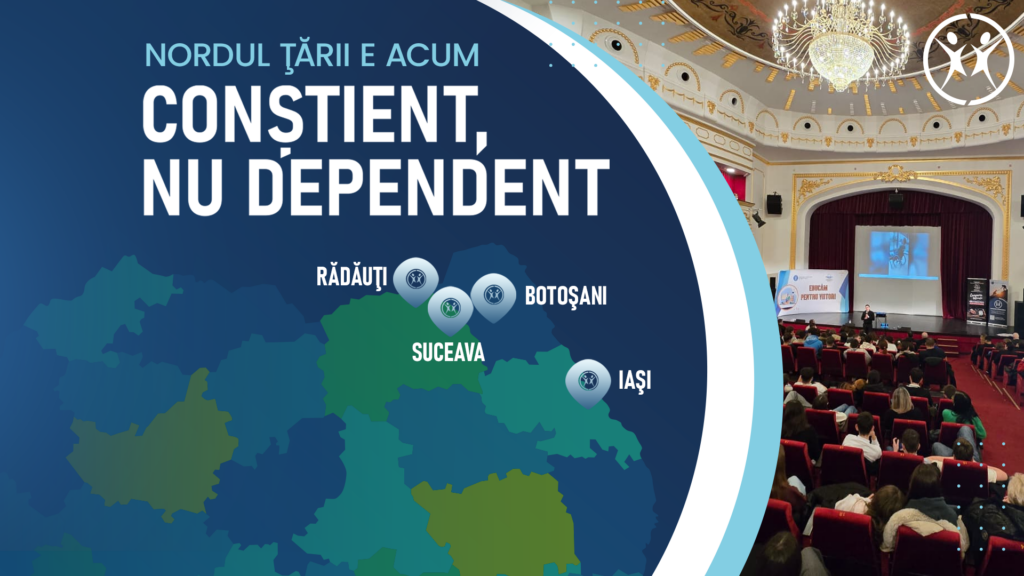
The Dan Voiculescu Foundation for the Development of Romania has successfully concluded the series of actions within the national anti-drug campaign "Aware, not addicted" carried out in the area of Moldova and Bucovina. The tour, which covered the cities of Botoșani, Iași, Suceava and Rădăuți, turned into a faithful barometer of the current social reality, demonstrating that the need for information is much higher than official estimates. During the month of February, thousands of students, parents and teachers participated in direct dialogues with experts, confirming that fragmented and distorted information online is now one of the main risk factors for young people.
The calendar of interventions has started on February 10 in Botoșani, where the stage of the "Mihai Eminescu" Theater hosted the first debates about the mechanisms of traffic and consumption. The campaign continued on February 11 in Iași, in the Aula of the "Alexandru Ioan Cuza" University, where the disturbing testimonies of former consumers offered a brutal lesson in the reality of the street. Later, on 16 February, the caravan reached Suceava, conducting interactive sessions at the "Ștefan cel Mare" University and Liceul cu Program Sportiv, before ending in Rădăuți on Tuesday 17 February, with conferences organized at Casa de Cultură and Gerald's Hotel. The meetings revealed a worrying conclusion: the age of contact with temptation is noticeably decreasing, with the first exposures occurring earlier and earlier, often as early as middle school.
The specialists' interventions were based on alarming international and national statistics, which lend weight to the educational approach. Studies indicate that about 9 out of 10 people who develop severe addictions started substance use before the age of 18. Worse still, recent analyses show that in Romania, the age of initiation has, in some cases, fallen even below 13. In this context, anti-drug expert Cătălin Țone and psychologist Gabriela Maalouf emphasized that effective prevention can no longer be based on intimidation or moralizing messages, but on developing solid life skills and understanding neurological and legal mechanisms.
A turning point in the meetings was the impact of authentic testimonies. The presence of young people who have overcome addiction but still carry the burden of the consequences of choices made at the age of 14 generated the strongest emotional reactions among high school students. These personal experiences were perceived as far more credible than any theoretical discourse, quickly debunking dangerous myths about "casual use" or "light substances" that would not cause addiction. The young people responded noticeably better to explanations of how synthetic drugs irreversibly affect brain circuits and educational pathways.
Beyond the dialog with the students, the campaign of the Dan Voiculescu Foundation for the Development of Romania validated the crucial role of the family and the school. In all four cities, school representatives and parents called for continuity, emphasizing that such interventions should not remain isolated episodes. There was a clear need for recurrent programs and practical tools for intervention, as the phenomenon is perceived as a constant vulnerability of the community. The overall conclusion was that the lack of genuine communication between adults creates the maneuvering space in which risk emerges, and the campaign succeeded in acting as a catalyst for dialogue, providing parents with specialized guides for identifying early signs of use.
Finally, the series of actions in the north of the country reconfirms the commitment of the Dan Voiculescu Foundation for the Development of Romania to support a safer generation through applied preventive education. The format of face-to-face meetings, tailored to the specific needs of each audience, has proven to be the most effective way to transform silence and prejudice into personal ownership and coordinated action. Although the stage in Moldova is now over, the Aware, not addicted mission continues at national level, promoting the idea that real prevention is built day by day, through close collaboration between specialists, parents and young people.