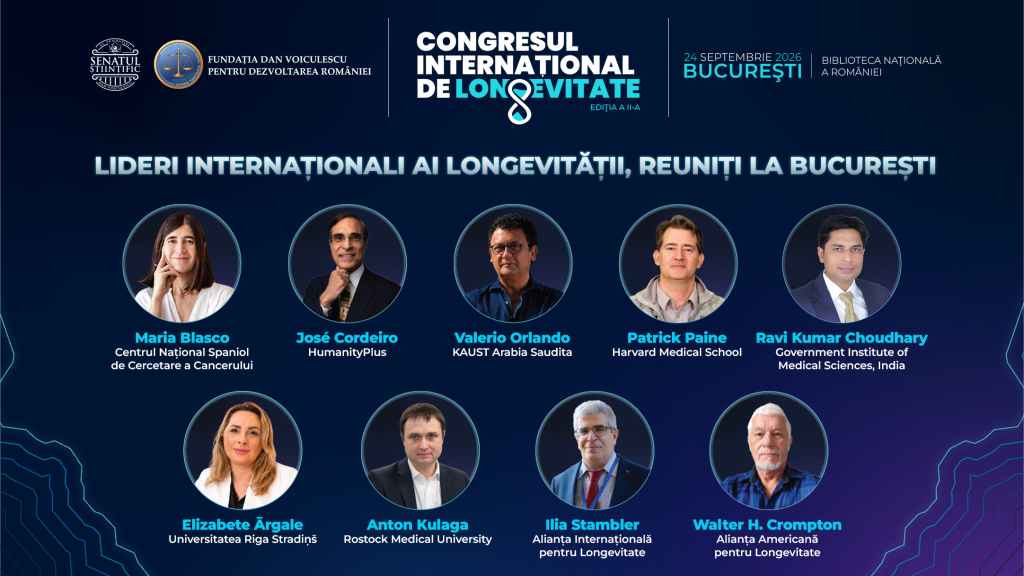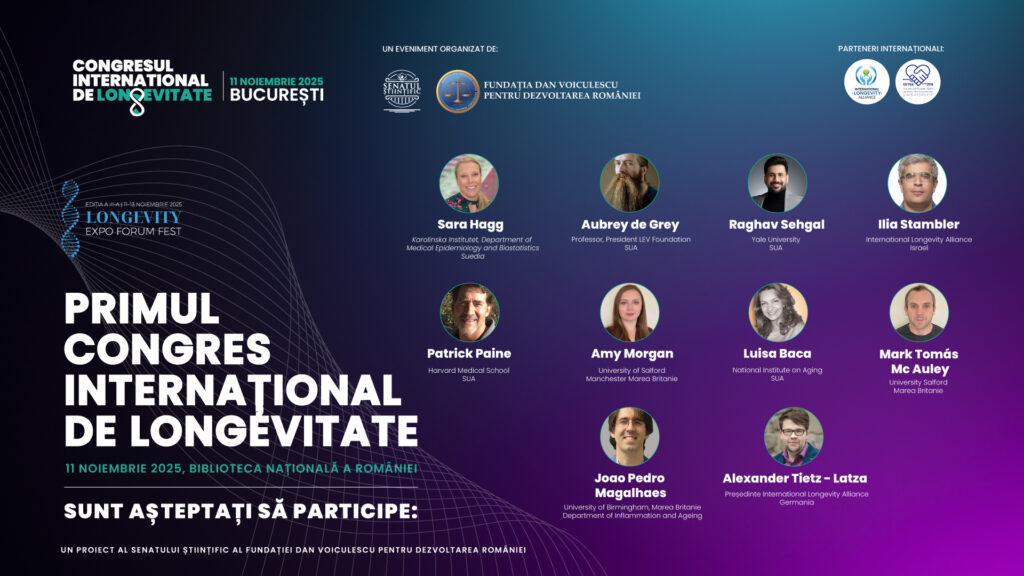
The Scientific Senate of the Dan Voiculescu Foundation for the Development of Romania is organizing the first International Longevity Congress in Bucharest - a landmark scientific event for Southeast Europe, bringing together some of the world's most influential experts in longevity, regenerative medicine, and public policy for extending healthy life. The International Longevity Congress will take place on Tuesday, November 11, at the National Library of Romania, and marks a first for our country in the international dialogue on the science of longevity.
Increasing life expectancy is one of the great challenges of the 21st century. The International Longevity Congress creates a framework for strategic dialogue for researchers, biologists, clinicians, professors, and experts from prestigious academic institutions such as Harvard Medical School, Karolinska Institutet, Yale University, University of Birmingham, National Institute on Aging (USA), and University of Salford.
Speakers at the International Longevity Congress – what topics define the future of longevity medicine
The biology of aging – understanding the underlying mechanisms
Sara Hägg (Karolinska Institutet, Sweden) presents the evolution of epigenetic biomarkers – indicators that allow the estimation of biological age and the assessment of disease risk before symptoms appear.
João Pedro de Magalhães (University of Birmingham, UK) shows how the genomes of animals with extreme longevity can inspire therapies to slow down aging in humans.
Mark Tomás McAuley and Amy Morgan (University of Salford, UK) analyses the relationship between metabolism, chronic inflammation and epigenetic changes in the ageing process.
Cell reprogramming and regeneration – from the laboratory to therapeutic interventions
Aubrey de Grey (LEV Foundation, USA) - Professor of biogerontology, known for the SENS model, supports the strategy of repairing cellular damage as a method of combating age-related diseases. He argues that the combined progress of biotechnology, tissue regeneration, and cellular reprogramming can lead to what he calls the "escape speed of longevity" – the moment when aging becomes treatable.
Patrick Paine (Harvard Medical School, USA) presents evidence that chemical reprogramming can rejuvenate cells and prolong the life of model organisms.
Luisa Baca (National Institute on Aging – USA) highlights the mechanisms of heart rate deterioration with age and the possibility of protecting cardiac function in the aging population.
Public policies and the ethics of longevity – how we transform science into societal strategy
Ilia Stambler (International Longevity Alliance, Israel) presents guidelines for integrating healthy longevity into national health plans.
Alexander Tietz-Latza (ILA, Germany) addresses the issue of the right to longevity as part of fundamental human rights.
Personalized medicine for longevity – from omic data to clinical decision
Raghav Sehgal (Yale University, USA) introduces multi-systemic models of aging analysis, which allow doctors to make decisions based on biological age, not just chronological age.
The Scientific Senate of the Dan Voiculescu Foundation for Development brings pioneering research in the field of longevity to Bucharest, at a time when science is proving that biological age can be measured and the aging process can be influenced. Romania is in a position to integrate the perspective of healthy longevity into national strategies through the International Longevity Congress, which will take place on Tuesday, November 11, at the National Library of Romania.