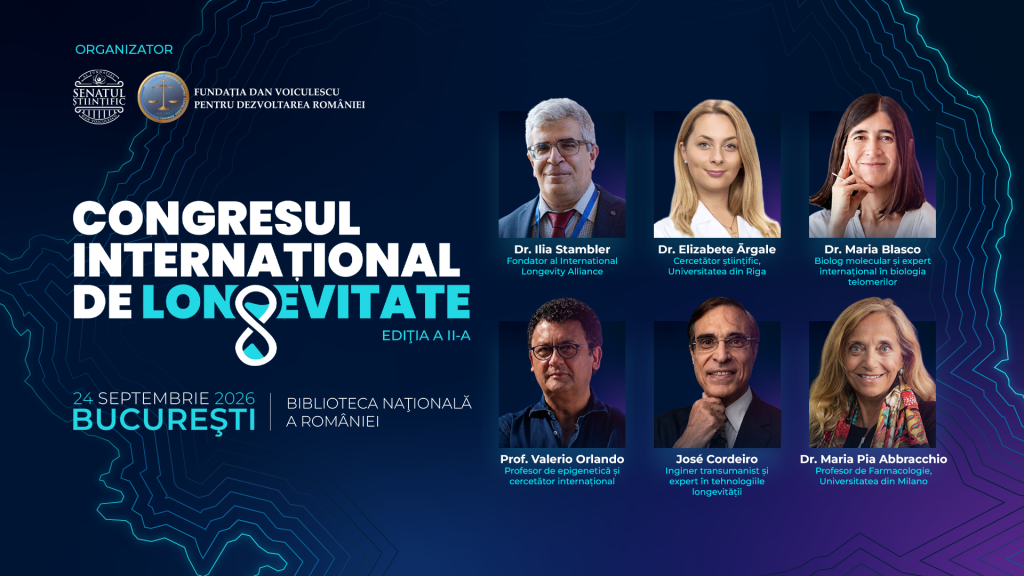
The Scientific Senate of the Dan Voiculescu Foundation for the Development of Romania is aligning the country’s medical research and practice with the highest international standards. It is bringing the latest discoveries, anti-aging technologies, and prevention protocols to Romania through the second edition of the International Longevity Congress – a landmark European scientific event scheduled for September 24, 2026, at the National Library of Romania. The congress is organized in partnership with the International Longevity Alliance and the VETEK Association – two international organizations dedicated to researching and promoting healthy longevity. The event serves as the opening for the 4th edition of the Longevity Expo Forum Fest, a project organized by Antena 3 CNN and Longevity Magazine. It marks the transition from fundamental research theory to direct implementation in clinical practice, with the primary goal of extending the period of healthy, functional life—a concept known in the medical world as “healthspan.”
Globally, medicine is undergoing a historic paradigm shift, moving from the mere treatment of diseases to direct intervention in the biological process of aging. At prestigious academic centers such as Harvard Medical School, researchers are already validating the feasibility of cellular reprogramming – demonstrating that an adult cell can be reverted to a youthful functional state – while experts at Sweden’s Karolinska Institute are developing epigenetic biomarkers capable of precisely measuring biological age and predicting disease risk before clinical symptoms manifest. Furthermore, the international scientific community is rapidly advancing toward what American specialists term “longevity escape velocity” – a milestone projected for the next 12-15 years, when biotechnology and regenerative medicine will be able to repair cellular damage faster than it accumulates in the body. It is against this dynamic backdrop that Romania is staking its claim to a seat at the global discussion table.
Each track of the International Longevity Congress is approached through the lens of clinical relevance and real-world potential for integration into modern medicine; thematic areas explore the cellular mechanisms of aging biology, the use of longevity biomarkers for long-term monitoring, innovations in regenerative medicine, and advanced artificial intelligence models applied to predictive medicine.
The event’s immense significance for the Romanian scientific community is underscored by the presence of world leaders who are currently shaping the future of healthcare. Among the international speakers bringing perspectives from the biology of aging, epigenetics, neuroscience, and future technologies to Bucharest are:
– Dr. Maria Blasco, a renowned molecular biologist and former director of the Spanish National Cancer Research Centre, whose work has revolutionized the understanding of the role of telomeres in tissue regeneration and the prevention of aging;
– Dr. Ilia Stambler, founder of the International Longevity Alliance, who will share his extensive expertise on integrating longevity medicine into global public policies;
– Transhumanist engineer José Cordeiro, who will explore the fascinating convergence of artificial intelligence and life extension.
This platform for international dialogue is further enriched by contributions from Professor Valerio Orlando, a world-leading expert in epigenetics, and researcher Elizabete Argale, whose work focuses on specific aspects of female longevity.
The International Longevity Congress is establishing itself as a cornerstone of medical innovation in Southeast Europe, building on the remarkable success of last year’s edition, which drew over four hundred in-person attendees. The audience comprised physicians, researchers, and academics eager to learn about new approaches to diagnosis and treatment. The twelve hours of presentations brought together thirty national experts and ten international speakers on the same stage – experts affiliated with world-renowned academic institutions such as Harvard Medical School, Yale University, and the Karolinska Institute.
The 2026 edition continues and expands upon this impressive legacy, offering Romanian healthcare professionals direct access to cutting-edge research and the tools needed to integrate state-of-the-art therapies into daily clinical decision-making.