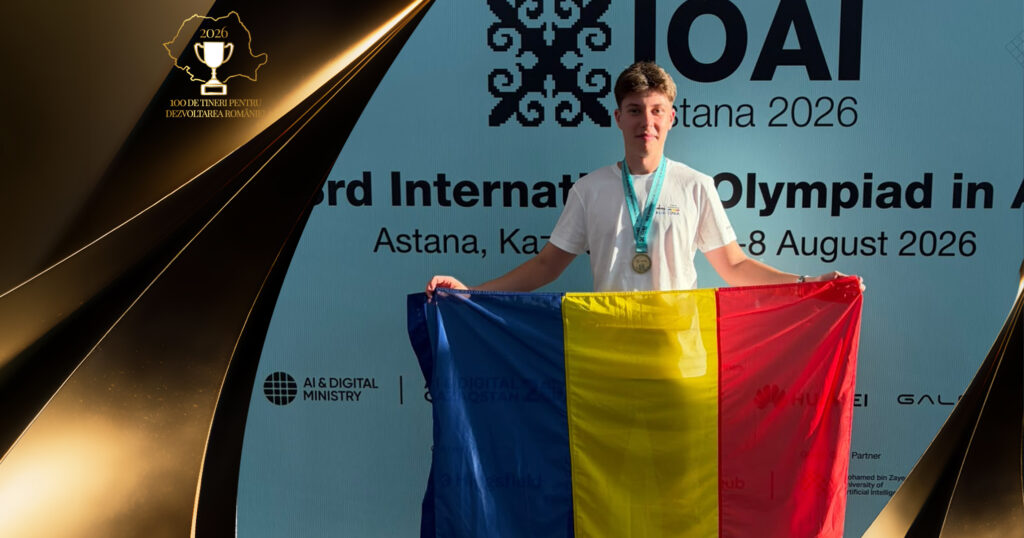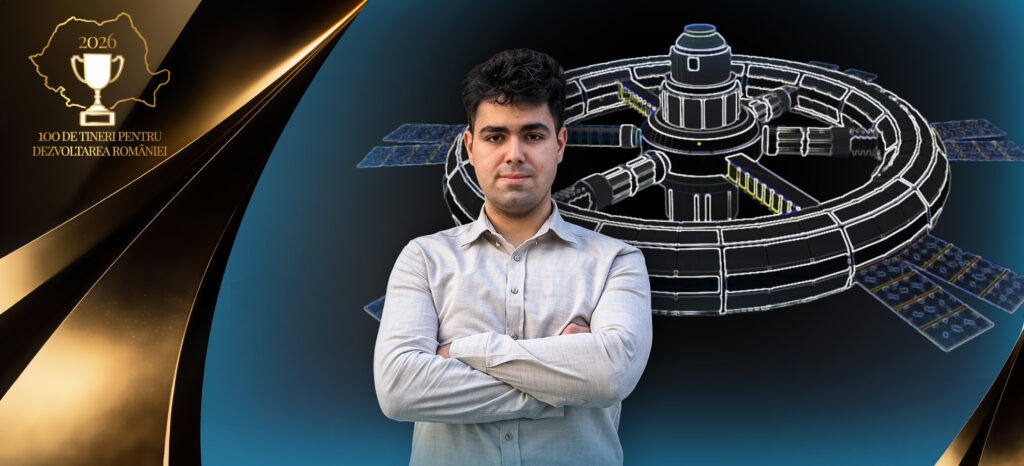
A Romanian student is proving that the future of space exploration begins in high school. Mihai Cheța, a 12th grade student at the “Sfântul Sava” National College in Bucharest, won First Prize in the prestigious international “NASA Space Settlement Contest,” organized annually by the National Space Society in collaboration with NASA. The competition is one of the most important global events in the field of space colonization concepts, bringing together in 2026 no fewer than 23,919 students from 31 countries around the world. Participants are challenged to design sustainable human habitats in space, combining solutions that integrate engineering, science, architecture, and the social dimension of life beyond Earth. Mihai Cheța’s performance was also recognised at national level, as he was included in the “100 Youngsters for Romania's Development” campaign, run by the Dan Voiculescu Foundation for the Development of Romania, a programme that highlights young people with exceptional results and the potential to shape the country’s future
Mihai’s winning project, titled “Hestia” is not merely a technical exercise, but a comprehensive vision of humanity’s future. The student, who is pursuing a mathematics and computer science profile, has built his path through constant study and a passion for physics and mathematics, transforming his academic interest into a project of global significance. “Hestia” stems from a fundamental idea: space exploration is not just about technology, but the ability to create a “home” beyond Earth. The project’s name, inspired by the goddess of home, reflects this ambition - to transform space into a habitable, stable, and human environment.
The proposed habitat is designed for a population of approximately 10.00 people and is strategically located at the Earth - Moon Lagrange 4 orbital point, chosen for its gravitational stability, nearly continuous access to solar energy, and ease of communication with Earth. The station’s architecture includes a rotating structure for generating artificial gravity, a non-rotating central hub, and connecting spines, clearly separating the microgravity zones from those intended for daily life. Beyond the design, Mihai rigorously addressed the aspects essential for survival: a bioregenerative life support system with 95% water recycling, integrated agriculture, and a closed-loop resource cycle. Safety is addressed at an advanced level through layered radiation protection, including the use of water as a shield, shelters for solar storms, and defense systems against micrometeorites. A distinctive feature of the project is the integration of the social dimension: governance, education, health, psychological well-being, and the economy, all designed for long-term, multi-generational development. “Hestia” thus becomes more than a space station - a model of civilization.
Its success confirms a remarkable trend: over the past two years, teams of Romanian high school students have dominated this international competition. The “Zenith Station” project by students from the “Sfântul Sava” National College and the “Nova 2” project by students from the “Tudor Vianu” National College also won the grand prize. Both teams were finalists in the “100 Youngsters for Romania's Development” campaign.
As space colonization gradually moves from the realm of theory to that of concrete plans, these high school students’ ideas point to a clear direction: the future is no longer just to be explored, but to be built, and Romania already has young people who know what that future might look like.