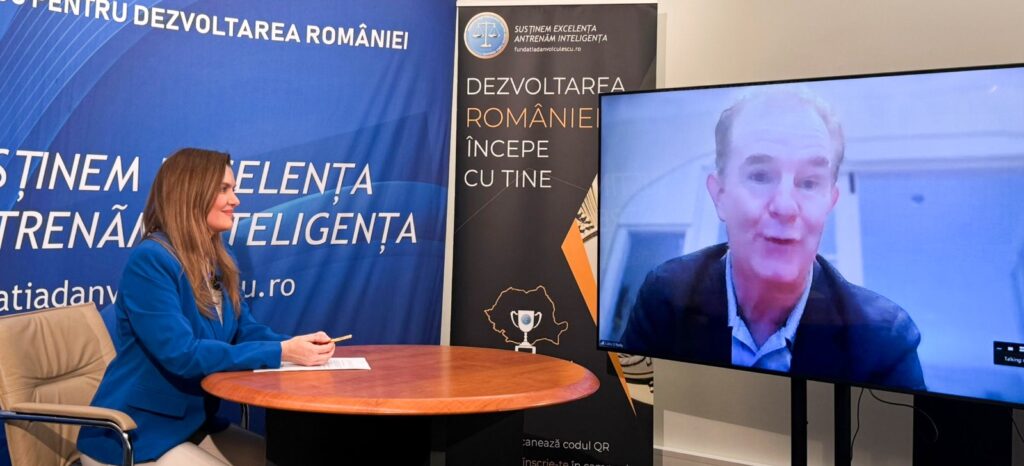
The Dan Voiculescu Foundation for the Development of Romania, an international affiliate of the European Council for High Ability (ECHA), conducted an interview-event with Dr. Colm O'Reilly, ECHA President and one of the most influential figures in the field of education for gifted young people worldwide. The dialogue focused on the need for new strategies to identify and support Romanian potential in the context of the current educational challenges in Europe.
ECHA is the leading European network dedicated to promoting the study and support of high potential individuals, facilitating communication between researchers, teachers and parents. The presence of Dr. Colm O'Reilly in a direct dialogue with the Dan Voiculescu Foundation for the Development of Romania underlines the international recognition of Romania's efforts to develop modern methodologies to support young people with high potential.
A highlight of the interview was the study "The neurocogognitive pattern of Romanian excellence", a unique national research conducted by the Dan Voiculescu Foundation for the Development of Romania, in partnership with the BrainMap Institute. This study uses advanced technologies, such as qEEG (quantitative electroencephalogram), together with psychological profiling and cognitive testing, to identify the specific fingerprint of brain functioning in children and young people with outstanding performance. The aim is to understand how high potential can be nurtured beyond simple IQ scores, providing personalized recommendations for teachers and parents.
Dr. Colm O'Reilly praised the value of this multidisciplinary multidisciplinary research, underlining the importance of an approach that goes beyond academic results: "There is little neurocognitive research in Europe dedicated to high potential young people, and combining this dimension with emotional profiling is a valuable contribution to the field. I think what you are doing is very useful and interesting. If you only look at IQ or school grades, you miss a big part of the picture. It is essential to understand the neurocognitive and psychological profile of these young people in order to be able to support them properly", said the ECHA President in the interview.
Ignoring high potential can have a long term cost to society. "Early intervention is much more effective than late intervention. If these children are not supported, they are unlikely to succeed at the level at which they could", he warns.
The dialogue also addressed persistent myths that affect the education of gifted young people, the most dangerous of which is that these children will manage on their own without extra help. Dr. O'Reilly stressed that the loss of human potential is a loss for society as a whole, and international collaboration is the key to success. In the interview, the ECHA President stressed that an increasing number of researchers argue that sustainable performance depends on regulation and resilience: "The balance starts with recognizing that sustainable excellence requires self-regulation, resilience and emotional support. Schools should create environments that encourage intellectual challenge as well as reflection, autonomy and stress management", points out Dr. Colm O'Reilly.
The interview marks an important moment of connecting Romanian research to international debate and confirms that the Foundation's approaches are in line with current European trends.
"Everything you are doing there is in line with the direction in which the field is evolving internationally," concluded the ECHA President.
Colaborarea dintre Fundația Dan Voiculescu pentru Dezvoltarea României și rețeaua europeană ECHA reafirmă angajamentul de a transforma potențialul românesc în performanță reală. Prin cercetare aplicată, parteneriate internaționale și programe dedicate tinerilor cu abilități înalte, Fundația contribuie la construirea unui model educațional care susține excelența pe termen lung, în beneficiul întregii societăți.